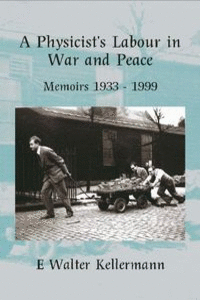
This book is of interest to historians of science and to scientists as well as to the general reader. Historians will be interested in theauthor\'s \'revealing view\' of the British pre war university system, the establishment of Theoretical Physics as a new discipline inBritain and his commitment to preserve science during the fundingbattles of the Thatcher years. Physicists will find a clearintroduction to the research into one of the greatest puzzles inastrophysics namely the enormous energies created in our cosmosmanifested by [ Auger\'s discovery ] of the \'Grandes Gerbes\', theshowers of particles currently incident on the earth now investigatedby a major international cooperation. The book. is \'a greatcombination of autobiography and history of the sciences during a long and exciting period of History\' (Stefan Sienell, Atistrian Academyof Sciences), \'A very, important source of reference\' (ProfessorJohn Dainton, Liverpool University). \'The book has authority andrelevance\' (Jeff Hughes, Manchester University), \'Perceptiveassessments of contemporary events\' (Geoffrey Cantor, Professor ofthe History of Science, Leeds University).
This book is of interest to historians of science and to scientists as well as to the general reader. Historians will be interested in theauthor\´s \´revealing view\´ of the British pre war university system, the establishment of Theoretical Physics as a new discipline inBritain and his commitment to preserve science during the fundingbattles of the Thatcher years. Physicists will find a clearintroduction to the research into one of the greatest puzzles inastrophysics namely the enormous energies created in our cosmosmanifested by [ Auger\´s discovery ] of the \´Grandes Gerbes\´, theshowers of particles currently incident on the earth now investigatedby a major international cooperation. The book. is \´a greatcombination of autobiography and history of the sciences during a long and exciting period of History\´ (Stefan Sienell, Atistrian Academyof Sciences), \´A very, important source of reference\´ (ProfessorJohn Dainton, Liverpool University). \´The book has authority andrelevance\´ (Jeff Hughes, Manchester University), \´Perceptiveassessments of contemporary events\´ (Geoffrey Cantor, Professor ofthe History of Science, Leeds University).
